Redaction vs. Anonymization: What Legal Teams Really Need
Understanding this distinction is becoming increasingly important as legal workflows evolve and AI adoption accelerates.
When Redaction Falls Short
Redaction is typically used to remove or obscure sensitive information from documents before sharing or review. While it plays an important role in certain contexts, redaction alone presents clear limitations:
- It permanently removes information, reducing context and meaning
- It breaks data consistency across documents
- It limits the ability to reuse data for analytics or AI
- It often relies on manual processes, increasing the risk of errors
For legal teams looking to collaborate, analyze data, or enable AI-driven workflows, redaction quickly becomes a bottleneck.
What Anonymization Enables
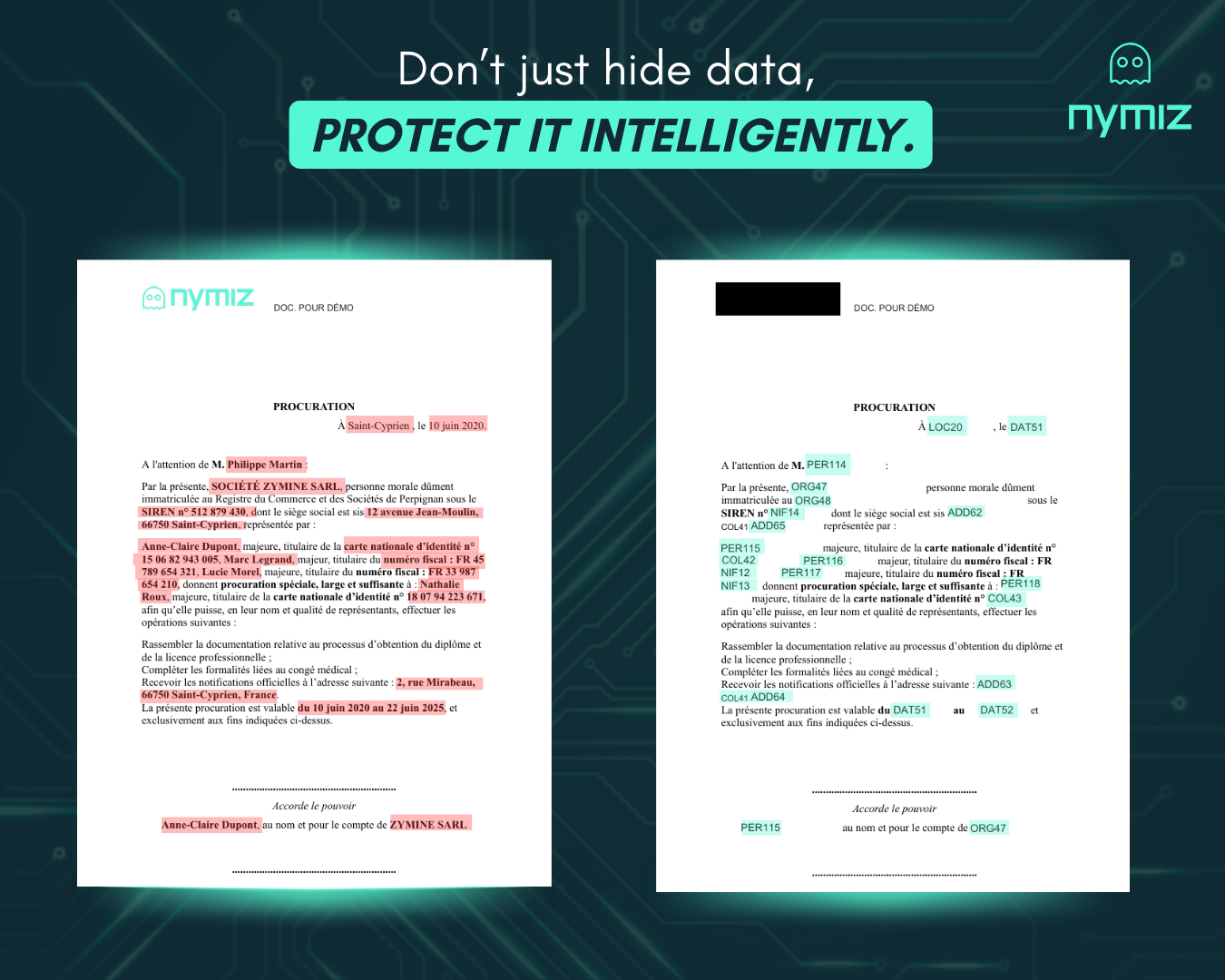
Nymiz anonymization takes a fundamentally different approach. Instead of simply removing sensitive information, anonymization transforms it in a structured and consistent way, allowing documents and datasets to remain usable.
When applied correctly, anonymization enables legal teams to:
- Preserve relationships, patterns, and context within documents
- Reuse data securely across workflows and teams
- Support analytics and AI initiatives using real data
- Reduce exposure without destroying data value
At scale, our anonymization offers approximately 85% accuracy in real-world environments, even across large document volumes and multilingual datasets spanning more than 200 languages, something manual redaction cannot realistically achieve.
Why the Difference Matters for Legal AI
AI systems rely on patterns, consistency, and context. Redacted datasets often lack the structure needed to produce reliable results, while properly anonymized data retains the signals that AI depends on.
As a result, legal teams that rely solely on redaction may struggle to scale AI initiatives, while those that adopt anonymization can move forward with greater confidence and accuracy.
Moving Beyond One-Size-Fits-All Approaches
At Nymiz, we help legal teams determine when redaction is appropriate and when anonymization is the better choice, and we automate both where possible.
Our technology:
- Identifies personal and sensitive data using advanced NLP and AI models
- Applies context-aware anonymization or redaction based on use case
- Ensures consistency across large document volumes
- Preserves legal structure and meaning where it matters most
This allows legal teams to protect data without compromising their ability to work with it.
Let’s Talk About What Your Workflows Really Need
During Legalweek 2026, we’re having conversations with legal and security leaders about how to move beyond basic redaction toward privacy strategies that actually support modern legal work.
If you’re attending and want to explore how anonymization can unlock secure collaboration, analytics, and AI, while still meeting regulatory requirements, we’d love to talk.
Join Us at Legalweek 2026
We’re meeting with legal and security leaders during Legalweek to discuss how privacy-first collaboration can scale without adding friction or risk.
Schedule a meeting with our team before Legalweek to make the most of your time in New York.
And if you’re onsite, you’ll find us at Booth 612.