Some attorneys decide to practice estate planning right after graduating from law school. Others practice in other areas, only to become curious about transitioning fully or partially into estate planning. Most attorneys who make this transition feel great satisfaction and little or no regret about making this career shift. There are many reasons why estate planning is such a rewarding practice area and many additional reasons why now could be the ideal time to make the switch.

Any Time Is a Good Time to Be an Estate Planning Attorney

Estate planning is known to some as “happy law,” as it is a stark contrast to other, more contentious practice areas like civil litigation and family law. Attorneys who have already chosen to include estate planning in their practice have cited the following reasons as to why they could not be happier with their decision.

1. It Is Low-Conflict

Unlike litigation or family law, estate planning, by its very nature, is not adversarial; it does not involve multiple parties playing a zero-sum game. With estate planning, you may occasionally have to discern conflict of interest issues between married clients or deal with your clients’ meddling family members. But overall, estate planning practice is low in conflict, and your clients may actually thank you for your help.

Further, in litigation or family law matters, clients are usually thrust into the legal process against their will, for example, if they are sued or need to fight a custody battle. When this is the case, clients may take their frustrations out on everyone and everything, including their attorney. With estate planning, clients are actively opting in to engage your services. They want the solutions you provide. They are in your office intentionally. This radically changes the way that clients interact with you.

2. It Allows for a Personal Connection with Clients

Estate planners work closely with clients and get to know them and their families personally. They can support people through life’s most significant milestones, such as births, deaths, marriages, and divorces. Further, this practice area allows you to know your clients over many years, often meeting and working with subsequent generations as well. Many practitioners find such relationships very rewarding and enjoyable.

3. It Offers Flexibility and Work-Life Balance

Working as an estate planning attorney allows great flexibility regarding work environment (they can work at a big firm or run a solo practice). There is also flexibility in terms of time management and scheduling. This allows estate planners to design a work life that suits them—and serves their clients—in the best possible way.

Practitioners may limit their hours to certain times of the day or certain days of the week. Some attorneys prefer to work evenings, which also works well for clients who work during the day. Attorneys can block off time in their schedule for doctor’s appointments or build their work schedule around family obligations. Because estate planners rarely, if ever, go to court, their schedule is not at the mercy of a judge.

Now Is a Particularly Good Time to Be an Estate Planning Attorney

The perks of being an estate planner explain why estate planning is such an enjoyable practice area. But there are many other reasons why now may be a perfect time to put your hat in the estate planning ring.

4. The Greatest Wealth Transfer in History Is Underway

As you may have heard, the United States is undergoing one of the greatest generational shifts this country has ever seen. Called the “Silver Tsunami” by some, this shift refers to the significant and rapid increase in the general age of the population. The WHO predicts that the number of people aged 60 and older worldwide will increase from 1 billion in 2020 to 1.4 billion by 2030 and 2.1 billion by 2050. As a result of this population shift, it is estimated that $84 trillion (that’s trillion, with a “t”) will change hands over the next 20 years in the United States alone. This transfer of wealth will primarily originate from the Baby Boomer generation (people born between 1946 and 1964) and will largely benefit Generation X (people born between 1965 and 1980), Millennials (people born between 1981 and 1996), and Gen Z (people born between 1997 and 2012).

Estate planning attorneys have an incredible opportunity to help facilitate this transition. Baby Boomer clients will need comprehensive estate plans to ensure their desired loved ones inherit their assets and that inheritances pass according to their wishes. Estate planners also stand to assist the recipients of this transfer of wealth. It is well known that the generations following the Baby Boomers—particularly Millennials—have delayed major life milestones such as marriage, starting a family, homeownership, and saving for retirement because of various economic and social factors. Until now, these generations may have seen little value in preparing an estate plan. Once they receive inheritances, however, estate planning may, and arguably should, become a top priority. Estate planning attorneys have the opportunity to educate potential clients about their options and the value of a comprehensive estate plan and could help protect this inherited wealth for future generations.

5. Americans Need Help Understanding New Complexities in Retirement Planning

For many Americans, retirement assets make up most of their wealth. Therefore, it is important for most people to understand the implications of passing these assets to loved ones. While some people create estate plans via online services such as LegalZoom and Rocket Lawyer, an experienced estate planning attorney can provide guidance, expertise, and options that will bring incredible value to a client

With the advent of the Setting Every Community Up for Retirement Enhancement Act of 2019 (SECURE Act) and the SECURE 2.0 Act of 2022 (part of the Consolidated Appropriations Act, 2023), the retirement planning landscape has significantly changed. The rules and regulations surrounding how people inherit certain types of retirement accounts are even more complicated and nuanced than before. Estate planning attorneys who take the time to understand the SECURE and SECURE 2.0 Acts can offer the significant legal knowledge and experience necessary to plan for these very important assets.

6. Potential Changes in Rules Offer Additional Planning Opportunities for Estate Planners

There are often changes made, or proposed, to the rules that impact estate planning decisions, at both the state and federal levels. Such changes may relate to the federal lifetime gift and estate tax exemption amounts, state estate taxation thresholds, or the assessment of capital gains taxes to name a few examples.

This is where an estate planning attorney can step in and provide significant value. With tools such as irrevocable trusts, irrevocable life insurance trusts, gifting strategies, and charitable planning, attorneys can assist clients in achieving their goals (such as eliminating or reducing estate tax liability or passing the greatest possible value on to loved ones) in the most effective ways. As with planning for retirement assets, the average American is not aware of these strategies, let alone able to make them function in the intended way all on their own.

Estate planning attorneys are uniquely qualified to counsel individuals on their options and tailor an estate plan that not only addresses estate tax concerns but also takes care of the client’s overarching desire to provide for their loved ones and pass on their legacy on their own terms.

What You Can Do to Get in the Game

Any new endeavor can be daunting, and shifting to a completely different area of law is no exception. Luckily, WealthCounsel has a program that will teach you the fundamentals of estate planning law and provide practical guidance on building your estate planning practice.

Estate Planning Bootcamp is a virtual, three-day workshop that will equip attorneys with the strong legal foundation and practice-building skills needed to confidently serve estate planning clients. Click here to learn more and see all upcoming Bootcamps.

 

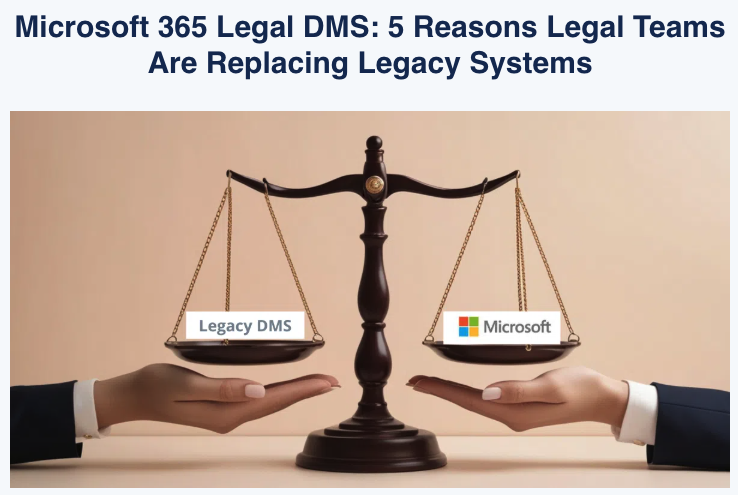
Legacy legal document management systems are being re-evaluated as legal teams modernize their workflows. Learn more about the 5 key reasons legal departments and law firms are moving from legacy DMS platforms to a Microsoft 365-centric approach — including improving governance, reducing complexity, and enhancing daily efficiency.

Read the full insights here: https://www.colligo.com/microsoft-365-legal-dms-5-reasons-legal-teams-are-replacing-legacy-systems/

By Ben Topolski, Global Alliances Leader, HYCU, Inc.

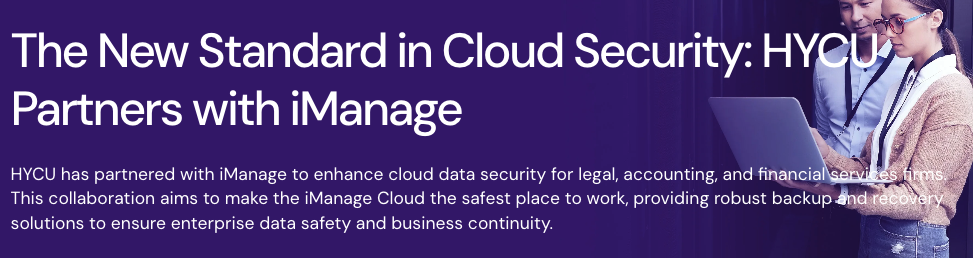
In a strategic move to bolster cloud data security, HYCU has partnered with iManage, a leading provider of secure document and email management solutions for legal, accounting, and financial services firms. This partnership aims to reinforce the iManage Cloud as the safest place to work, offering robust iManage backup and recovery solutions that ensure enterprise data safety and business continuity.

Enhancing iManage Cloud with HYCU’s Expertise

The integration of HYCU’s backup and recovery technology with the iManage Cloud platform provides comprehensive data protection for sensitive documents and emails. This collaboration focuses on several key areas:

  1. Data Protection: The partnership enhances iManage Cloud’s capabilities in safeguarding critical business data through advanced backup and recovery solutions.
  2. Cloud Backup: HYCU’s cloud-native solutions ensure seamless and reliable backups, vital for maintaining data integrity and supporting business continuity.
  3. Secure Document Management: iManage’s robust document management system is now fortified with HYCU’s cybersecurity measures, ensuring secure storage and management of sensitive information.
  4. SaaS Integration: The seamless integration of HYCU’s services with iManage Cloud offers an enhanced user experience, simplifying IT infrastructure management for enterprises.

Key Benefits for Enterprises

This partnership delivers several benefits, particularly for industries where data security and compliance are paramount:

  • Legal Technology: Law firms can now leverage enhanced legal technology tools for secure and compliant data management.
  • Compliance and Governance: The combined solution supports compliance with industry regulations, ensuring governance and data integrity.
  • IT Infrastructure: Simplifies the IT infrastructure with integrated backup and recovery solutions, reducing the complexity and costs associated with managing multiple systems.
  • Business Continuity: Ensures that critical business operations can continue uninterrupted in the event of data loss or cyber incidents.

Why This Matters

In today’s digital landscape, where data breaches and cyber threats are increasingly common, the HYCU and iManage partnership represents a significant advancement in enterprise data safety. By leveraging HYCU’s expertise in cloud backup and recovery, iManage Cloud users can now benefit from enhanced security, reliable data protection, and streamlined IT operations.

This collaboration not only strengthens the cybersecurity posture of businesses but also supports their compliance and governance efforts, ensuring that sensitive data is managed securely and effectively.

For more information, you can read the full announcement on iManage’s website.

Conclusion

The partnership between HYCU and iManage is a testament to their commitment to providing top-tier data protection and secure document management solutions. As cyber threats continue to evolve, such collaborations are essential in ensuring that businesses can protect their data, maintain compliance, and ensure uninterrupted operations.

Interested in learning more?

https://www.hycu.com/blog/new-standard-cloud-security-hycu-partners-imanage

Cat Casey, known to many in legal tech as “Technocat,” had a great interview with Brian Kelley, VP of Product at CloudNine about one simple theme: Choice matters more than ever in modern eDiscovery.

Why On-Prem and Flexible Deployment Are Resurfacing

It’s easy to frame on-premise deployment as a relic of the past. But that’s not what we’re seeing.

In certain environments like regulated industries, government and sensitive investigations control of the data still matters. Data residency matters. Air-gapped review environments matter.

What we discussed is not nostalgia. It’s response as many eDiscovery platforms are moving to “Cloud Only” options.

Modern eDiscovery teams want:

  • Cloud when speed and scale matter.
  • Ability to manage ALL data types both traditional and modern
  • On-prem when control and security matter.
  • Hybrid when reality demands both.

Choice is no longer a luxury feature, it’s a risk management strategy.

https://cloudnine.com/ediscoverydaily/why-choice-matters-in-modern-ediscovery-technocat-podcast-cat-casey/


How much time could lawyers reclaim if email filing and governance were automated?

This latest case study shows how one firm using Colligo Email Manager for Microsoft 365 saved more than 20 hours per lawyer, every month — streamlining email organization, improving governance, and reducing administrative drag.

See the results for yourself: 
https://www.colligo.com/saving-over-20-hours-per-lawyer-per-month-with-email-manager

Legal data rarely stays in one place.

From the moment it is collected, legal data moves across systems, teams, tools, and external partners. It is stored, reviewed, analyzed, shared, reused, and increasingly processed by AI-driven technologies. Yet many legal data protection strategies still focus on a single moment: when data is “at rest.”

In today’s legal workflows, that approach is no longer sufficient.

The Problem with Point-in-Time Protection

Protecting legal data only when it is stored ignores where most risk actually occurs — when data is actively being used.

Legal teams routinely expose sensitive information during:

  • Document review and investigations
  • Collaboration with external counsel or service providers
  • Internal knowledge sharing and analytics
  • AI model training and testing

When privacy controls are applied too late or only at specific stages, risk accumulates silently across the workflow.

A Lifecycle-Based Approach to Privacy

To truly protect sensitive legal data, privacy must follow the data wherever it goes.

Nymiz enables legal teams to apply privacy protections from the very beginning of the data lifecycle, ensuring that sensitive information is safeguarded consistently across:

  • Collection – personal and sensitive data is identified and protected as soon as it enters the workflow
  • Storage – privacy-safe data can be retained without increasing exposure
  • Use – teams can work with protected data for review, analytics, and AI
  • Sharing and reuse – data can be shared internally or externally without reintroducing risk

Because this approach is applied at the infrastructure level, it works consistently across a wide range of formats (from documents and presentations to text files and images) and across more than 100 languages, ensuring protection follows the data wherever it goes.

Supporting Modern Legal Workflows

With lifecycle-level privacy in place, legal teams can:

  • Reduce risk without slowing down operations
  • Enable collaboration across teams and vendors with confidence
  • Maintain control over sensitive data beyond organizational boundaries
  • Support AI and analytics initiatives using real, protected data

Rather than treating privacy as a final checkpoint, legal teams can make it a continuous safeguard.

Join Us at Legalweek 2026

We’re meeting with legal and security leaders during Legalweek to discuss how privacy-first collaboration can scale without adding friction or risk.

Schedule a meeting with our team before Legalweek to make the most of your time in New York.

And if you’re onsite, you’ll find us at Booth 612.

See recent case studies, AI resources, and innovations, all grounded in defensible process and real-world results.

As the legal industry gathers this week, TCDI is showcasing the work behind the conversations. We’ve launched a dedicated Legalweek Event Page designed for those who want more than buzzwords. Inside, you’ll find our latest case studies, thought leadership, AI resources, and product innovations, all grounded in defensible process and real-world results.

From earning the 2025 LegalTech Breakthrough Award for Best Use of AI in eDiscovery for the second consecutive year, to consistently helping clients achieve measurable results, TCDI continues to focus on what matters most to legal teams. Practical innovation. Smarter data strategy. Process-driven AI that stands up in court and scales in practice.

Explore the page to see what we’ve been building and how it can support your next matter: https://www.tcdi.com/legalweek-2026/

Your SaaS vendor’s recycle bin shouldn’t be a backup strategy.

One of Germany’s largest law firms realized this before it was too late.

Click to see how HEUKING protects iManage Cloud data, even during disruptions, with HYCU.

How much time is your firm spending on manual email filing?

In this case study, Fournier details how adopting Colligo Email Manager for Microsoft 365 helped improve matter organization, reduce time spent managing email, and enhance compliance with legal retention requirements.

The result: stronger governance and more time for client-focused work.

Read more: https://www.colligo.com/legal-department-saves-up-to-80-hours-a-year-per-person-with-email-manager/

Turn institutional knowledge and best practices into structured, repeatable processes, scaling standards across teams.

Click to learn more.