
Company adds 35+ ​​engineering and product specialists to growing team while Consilio doubles down on RPD to power private-cloud review inside its Aurora platform 

CHICAGO (March 10, 2026)  – Reveal today announced a major expansion of its private deployment (RPD) capabilities in direct response to accelerating demand from enterprises that require control over data residency, security and compliance.

With legacy on-premise platforms sunsetting by 2028, enterprises face the choice to move to public cloud or stay stuck on aging infrastructure. Reveal is proving there’s a third option. Consilio validated that bet by bringing RPD directly into its Aurora platform, establishing Reveal as Consilio’s premier private cloud review partner.

“The choice shouldn’t be innovation or control,” said Eric Harmon, CEO of Reveal. “Organizations are telling us they need both. We’re investing aggressively in private deployment to prove they can have it.”

Consilio’s Vote of Confidence

Consilio recently selected RPD as the premier privately deployed review platform inside Aurora, its digital enterprise platform that unifies legal data, workflows and dashboards and serves Fortune 500 companies and Am Law 200 firms globally.

The partnership formalizes years of collaboration through joint enablement programs, training and client certifications.

“Clients want access to strong review tools, but not at the cost of giving up control over their data or being forced into a deployment model that doesn’t fit,” said Meredith Kildow, President, Consilio. “Partnering with Reveal to provide RPD in Aurora eliminates that trade-off, giving legal teams a private-cloud environment with the governance and workflow control they need.”

More importantly, it signals a broader market shift. The legal industry is moving beyond dependence on a single legacy platform. Consilio’s decision to diversify its infrastructure with Reveal reflects growing recognition that monopoly reliance creates risk.

The Power of Choice

Reveal’s approach is built on flexibility at every level. RPD delivers true deployment flexibility with its public cloud, private deployment and hybrid models, giving enterprises control over where their data lives. As other platforms eliminate deployment options, Reveal is expanding them.

“Some vendors are narrowing choices. We’re expanding them,” said Harmon. “Organizations should pick the deployment model that fits their security posture, regulatory requirements and business strategy. Not the other way around.”

RPD Investment Delivers

The RPD team build out and the increased investment is focused on making RPD as easy to deploy and manage as Reveal’s cloud offering:

  • Release parity with SaaS: RPD now runs on the same release branches as Reveal’s cloud platform and has an identical code base, ensuring enterprises get new AI features and security updates at the same pace as cloud customers.
  • Enterprise deployment playbooks: Comprehensive documentation covering Kubernetes, SQL configuration, storage architecture and security controls cuts deployment time and reduces complexity.
  • Validated bare-metal options: Full validation across Windows and Linux nodes gives organizations maximum infrastructure flexibility.
  • White-glove support: Dedicated engineers guide clients from architecture planning through ongoing optimization.

Now is the Moment

Financial services, government, healthcare and other regulated industries face real constraints around data residency, security and compliance. Public cloud isn’t always an option, but staying on aging on-premise infrastructure that can’t support modern AI is becoming indefensible.

RPD delivers the same AI capabilities as the cloud platform, which includes ‘aji’ for automated document review, ASK for natural language fact-finding and data analysis and Reveal’s underlying powerful AI engine.

The Consilio partnership proves the approach works at scale. The expanded investment ensures Reveal can meet demand as more enterprises make the transition.

For more information about RPD, visit revealdata.com/rpd.

###

About Reveal

Reveal is the provider of the two leading AI-powered eDiscovery platforms in the legal industry: Reveal Logikcull with its self-service option, and Reveal’s enterprise-grade, feature-rich platform, both driven by the most powerful AI engine in the industry. The company has a deep history in driving the adoption of legal automation, which is underpinned by its leading processing technology, visual analytics, and artificial intelligence capabilities. Reveal’s software combines technology and human guidance to transform structured and unstructured data into actionable insight. We help organizations, including law firms, corporations, government agencies, and intelligence services, uncover more useful information faster by providing a world-class user experience and AI technology that is embedded within every phase of the eDiscovery process.
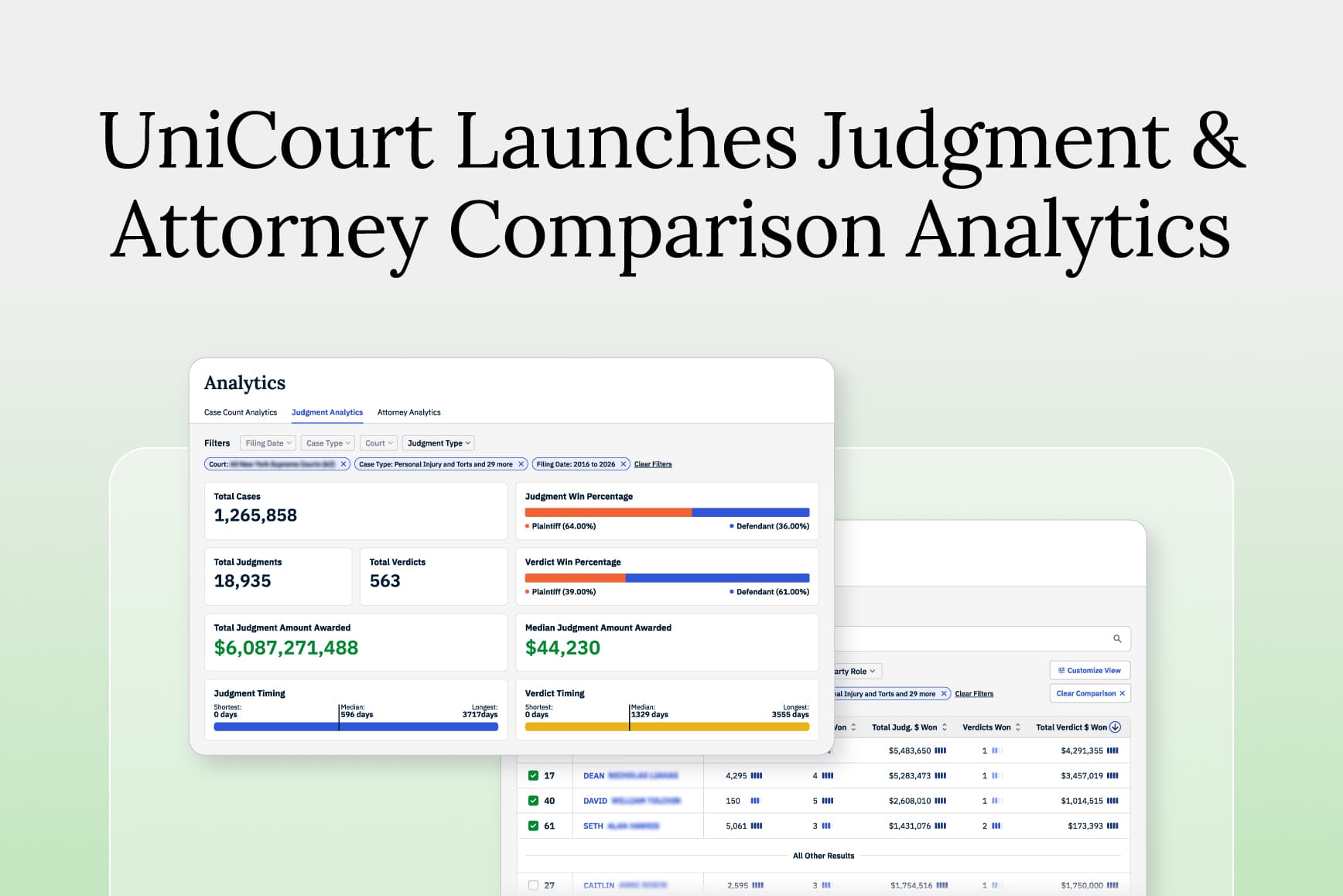
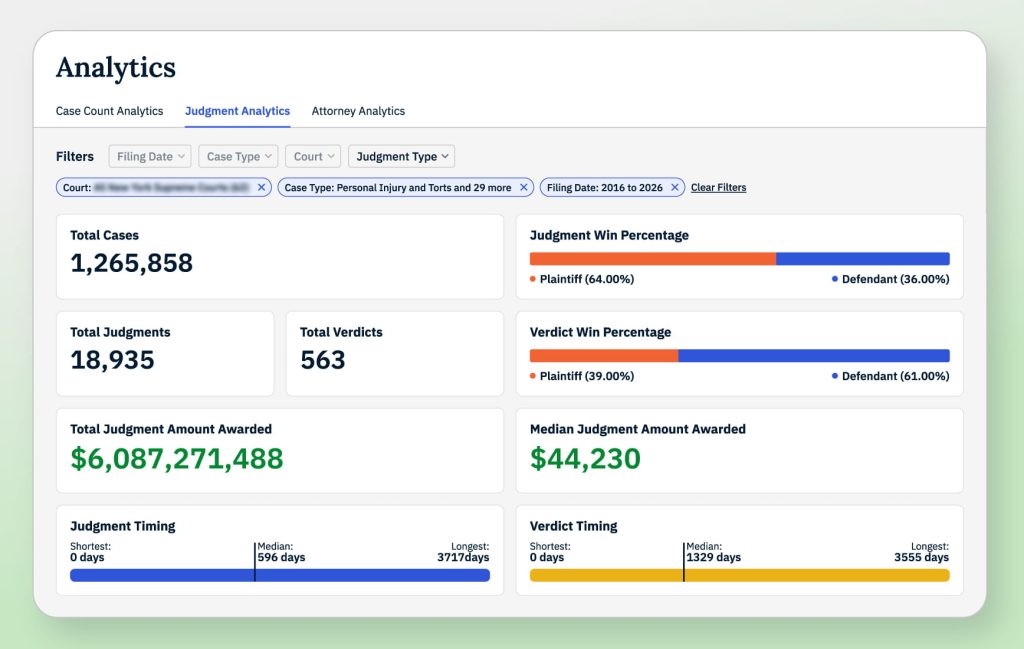
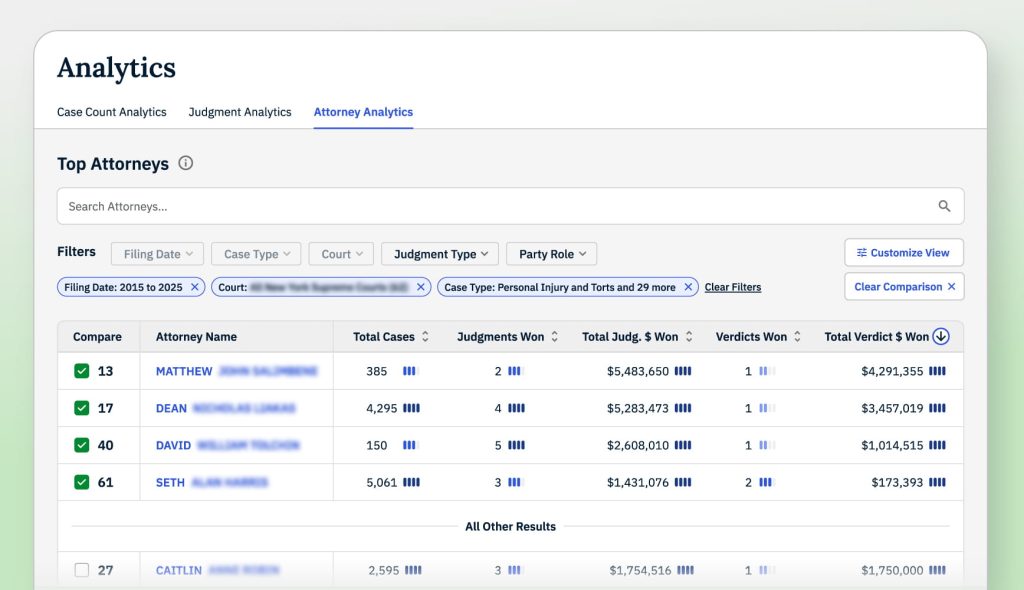
UniCourt Launches New Legal Analytics for DART Featuring Judgment and Attorney Comparison Analytics

UniCourt is proud to announce a groundbreaking release: judgment analytics and comparison of attorneys by key metrics such as trial experience and judgment outcomes. This new suite of analytics is a significant expansion of UniCourt DART (Docket Analytics, Research, and Tracking) and will enable legal professionals to assess case values and counsel performance based on actual trial outcomes.

Data-Driven Judgment Analytics

By leveraging UniCourt’s new judgment analytics, legal professionals can easily:

  • Benchmark award metrics by viewing total damages granted and the median amount awarded for specific case types.
  • Identify outcome trends to determine the likelihood of certain cases proceeding to a final judgment or verdict.
  • Evaluate success rates by analyzing the proportion of judgments and verdicts resolved in favor of plaintiffs versus defendants.
  • Anticipate timing by viewing the median time it takes to reach judgments and verdicts.

Advanced Attorney Comparison

By using UniCourt’s sophisticated attorney comparison tool, legal professionals can easily:

  • Assess litigation experience by comparing total case counts and the number of judgments/verdicts awarded.
  • Analyze win/loss records to identify attorneys with the strongest performance metrics by absolute number of judgments and verdicts won, as well as overall win percentages.
  • Compare damages awarded to see the total and median amounts won.
  • Conduct head-to-head comparisons between specific attorneys or opposing counsel to inform litigation strategy and counsel selection.

Users can now answer complex questions about litigation trends and attorney experience, such as:

  • What’s the median jury award for a personal injury case, and is this specific jurisdiction more favorable to plaintiffs or defendants?
  • How long should I expect a case to last if it goes to judgment? What if it goes to trial?
  • How does my panel of attorneys compare against each other? Who is the best attorney for this case if it goes to trial?

Integration into the Litigation Knowledge Graph

These new analytics are built into UniCourt’s exclusive Litigation Knowledge Graph, which connects cases, claims, facts, and outcomes directly to the underlying documents and key players involved (attorneys, law firms, judges, and parties). This provides a comprehensive view of the crucial relationships and outcomes most relevant to any specific case.

Learn More about UniCourt’s New Judgment Analytics and Attorney Comparison

UniCourt’s new judgment analytics and attorney comparison tools are currently available for a selection of key state trial courts, with a nationwide expansion coming soon.

You can learn more about UniCourt’s platform here, see our full press release here, or contact a UniCourt Litigation Data Expert here.


Evolving from systems of record to systems of action, Litify integrates AI-driven insights, scalable workflows, and open ecosystem flexibility to help legal teams operate at their full potential. 

NEW YORK, NY — (The Edge Room) — Litify, the all-in-one legal platform powering legal’s top performers, today officially launched its AI-native Platform of Action, a unified foundation designed to help legal teams turn insight into execution and move work forward with greater speed, visibility, and intelligence. 

Legal work is high stakes. The systems behind it often aren’t. 

Law firms and corporate legal departments continue to rely on disconnected tools, manual workflows, and legacy systems that slow performance and obscure visibility. As AI reshapes the technology landscape, legal teams face a new challenge: how to turn insight into execution without adding more complexity.

For the past decade, Litify has served as a secure, trusted system of record for legal operations, centralizing matters, documents, billing, reporting, and data in one enterprise-grade, open platform built on Salesforce. Building on that foundation, Litify is now advancing into its next chapter by embedding next-generation AI-driven actions directly into workflows, which prepares legal teams for a more intelligent, AI-enabled era of execution. 

The result: fewer administrative burdens, clearer visibility across teams, and the ability to surface next-best actions within the flow of work and legal context. Instead of toggling between systems or chasing updates, legal professionals can focus on strategy, advocacy, and outcomes. 

“AI alone doesn’t transform legal operations,” said Curtis Brewer, CEO of Litify. “Execution does. We’ve spent ten years building the foundation where legal work lives. The Platform of Action is about ensuring that work moves forward intelligently, securely, and at scale.” 

Unlike narrow point solutions that address isolated use cases, Litify’s open and configurable ecosystem is designed to scale with organizations over time. Its architecture allows firms and in-house departments to integrate strategic partners, tailor workflows, and scale performance without the disruption of re-platforming every few years. 

In the past year, Litify has released 10+ AI agents to proactively execute next best actions, orchestrate complex workflows across teams, and drive end-to-end case progression. These tools don’t just surface insights; they act on them, helping modern legal teams reduce manual coordination, accelerate resolution, and operate with greater precision. The company’s AI agents now include:

  • Conflict Check Agent: Generate custom conflict checks from anywhere on the matter using smart “fuzzy matching” to catch potential conflicts across your entire case history. Create a permanent report so you never miss a conflict due to inconsistent data entry.
  • LitifyAI Agentic Case Expert: Autonomously analyzes matter data to flag strategic risks and executes complex multi-step workflows, ensuring your legal strategy stays ahead of the curve while the administrative heavy lifting happens behind the scenes.
  • LitifyAI Ask: Ask anything of your documents and data, from a single file to your entire firm history, and share high-performing prompts across your organization to streamline consistency in how staff uses AI.
  • LitifyAI Draft: Draft new documents requiring narrative and analysis, and edit existing documents or drafts directly in LitifyAI. Adjust text, refine tone, layer in prompts, and more.
  • LitifyAI Damages Assistant: Generate accurate, source‑linked medical chronologies and organize medical encounters and bills into a reconciled ledger — while signals immediately trigger tasks, approvals, and workflows.
  • LitifyAI Summarize: Process, summarize, and analyze transcripts from court proceedings and depositions. Transcripts can be saved as a file in Litify and edited with LitifyAI Draft.
  • LitifyAI Instant Demands: Automatically generate a demand packet with the data in Litify. Once the demand is ready for review, you can open the draft with a single click and continue refining it in LitifyAI Draft.

As part of this next chapter, Litify is also launching Close Ups, a new podcast hosted by Brewer that features candid conversations with leaders from organizations such as Salesforce, Expedia Group, and Workday. The series reflects Litify’s broader commitment to supporting the legal operations community as it adapts to rapid technological change. 

This evolution marks a refinement (not a reinvention) of Litify’s mission: to help every legal team — and every teammate — operate at their full potential on the last legal platform they will ever need. 

Litify has always powered legal work. Now, it’s powering how that work moves forward. 

###

About Litify

Unleash your team’s full potential.

Litify is powering a new era for the legal industry. Since its inception in 2016, Litify has helped law firms and corporate legal departments turn operations into impact through its leading AI-native platform of action. With over 55K legal professionals and 450+ enterprise clients across plaintiff, insurance defense, immigration, and the Fortune 500 — the industry-leading solution combines trusted cloud-based technology, configurable and AI-native workflows, and powerful business analytics. Additional capabilities include matter and intake management, document generation, timekeeping and billing, legal hold and corporate eBilling, mobile, and more.

By integrating next-generation AI actions and insights across the platform, Litify offers a future-ready solution that enhances strategic decision-making, increases client satisfaction, and enables every teammate to operate at their full potential.

To learn more and request your personalized demo, visit www.litify.com.

Media Contact 

Society22 PR

litify@society22pr.com 


FTI Consulting, Inc. announced that adoption for IQ.AI by FTI Technology is growing among the world’s largest corporate legal departments and law firms, and introduced IQ.AI Studio, a proprietary library of artificial intelligence tasks, models and processes. IQ.AI is patent pending and combines proprietary workflows and expertise with generative AI technology from FTI Technology and its software partners. Launched in 2024, IQ.AI is proven across engagements including antitrust and competition review, post-breach data mining and analysis, cross-border litigations and complex investigations in the Americas, Europe, Asia and Australia. IQ.AI is the most comprehensive and flexible generative artificial intelligence solution on the market, having transformed complexity into clarity on hundreds of matters for multinational corporate clients and law firms, and with the addition of IQ.AI Studio, it further enhances flexibility and global scalability to drive insights and efficiency.


Customer results highlight growing demand for unified drafting, comparison, and collaboration within Microsoft 365 and web 

NEW YORK – Legalweek 2026 – Mar. 10, 2026 –Litera, a global leader in legal AI technology solutions, shared new customer results at Legalweek demonstrating how law firms are transforming document workflows and realizing immediate value with Litera’s AI-powered drafting and compareHand Arendall Harrison Sale, one of the largest law firms in the Southeastern U.S. with more than 85 lawyers across Alabama and Florida, recently deployed Litera One as part of a broader technology modernization initiative. By unifying drafting, comparison, and collaboration directly within Microsoft 365 and extending workflows to web and mobile, the firm streamlined document processes and eliminated long-standing friction for attorneys.

Prior to implementation, document comparison tools were creating friction among some of the firm’s most experienced users. After adopting Litera One’s drafting capabilities, the firm recorded zero complaints and just a single Help Desk call following rollout, signaling immediate user adoption and measurable operational impact. 

The results reflect a broader shift across the legal industry as firms move toward unified, embedded workflows that reduce context-switching and accelerate time to value. Litera One brings together the tools attorneys rely on every day – drafting, review, knowledge, and performance workflows – into a single experience across Word, Outlook, web, and mobile environments. 

Amplifying the platform is Lito, Litera’s AI legal agent, which transforms firm knowledge into real-time, context-aware intelligence. Lito helps lawyers understand intent, recommend next steps, and navigate drafting, review, and knowledge management workflows with greater speed and confidence. Lito was recently honored with a 2025 AI Core Technology Award from TMCnet, recognizing the next generation of AI applications by providing the platforms and infrastructure that turn AI potential into real-world impact. 

“Law firms are under more pressure than ever to do more with less, and experiences built on the Litera One platform delivers on that promise from day one,” said Joey Benedek, VP of Product at Litera. “What we’re seeing with firms like Hand Arendall Harrison Sale isn’t just faster document workflows. It’s a fundamental shift in how lawyers work — with less friction, more confidence, and more time for the work that matters. When you combine that with the intelligence of Lito, our AI orchestration layer,  you’re not just modernizing a process. You’re transforming a firm.” 

With deep integration into leading document management systems including iManage and NetDocuments, Litera One also enables document governance protocols to remain intact while dramatically improving the attorney experience. 

To see Litera One’s AI-powered drafting live, visit Litera at booth #401 at Legalweek, March 9-12, 2026, at the North Javits Center in New York, NY. 

For more information on how Hand Arendall Harrison Sale achieved immediate ROI, visit: https://www.litera.com/customers/case-study/frustration-flow-how-hand-arendall-harrison-sale-achieve-immediate-roi-and-transformed-document 

For more information on Litera’s integrated AI drafting, visit: https://www.litera.com/litera-one 

For more information on Litera at Legalweek, visit: https://www.litera.com/legalweek 

About Litera  
Litera is a leader of the legal AI revolution, on a mission to Raise The Bar™ for the legal profession by delivering transformational, globally-trusted solutions to law firms and corporate legal teams worldwide. The company’s comprehensive suite of Generative and Agentic AI-driven tools powers and unifies workflows across three key pillars: Legal Workflow & Drafting, Firm Intelligence & Knowledge Management, and Business Development with next-generation Proactive Relationship Management (PRM) capabilities. Integrated directly into where lawyers work in Microsoft 365 and across devices, Litera enables legal professionals to effortlessly create exceptional work, win more business, and streamline operations. This is all accomplished with seamless governance and data security through AI, dramatically reducing context-switching. With more than 30 years of legal tech innovation, a majority of the world’s largest law firms as clients, and 2M+ daily users, Litera is the proven, trusted platform that takes modern legal practices to the next level. For more information, visit litera.com or follow us on LinkedIn.    

Litera Press Contacts:  
Jared Albert
PR & Communications Strategist
jared.albert@litera.com

Tracy Wemett
BroadPR, Inc. for Litera
twemett@broadpr.com
+1-617-939-3631

###


When Project Fortress was being built, the question of infrastructure wasn’t a minor technical decision — it was the whole bet. Get the foundation wrong, and everything built on top of it would eventually crack. Get it right, and the platform could do things no point solution ever could.

That’s why Fortress runs on Salesforce. Not because Salesforce is a legal technology company, but precisely because it isn’t one.

  1. Your clients already run on it.

Salesforce is used by 90% of the Fortune 500. For law firms, that means building on a platform their corporate clients already operate within — not asking those clients to learn a new environment or wait for IT to vet another vendor. For attorneys working inside corporate legal departments, it means working on infrastructure the company already uses and trusts. The practical effect is significant: matter data, deal progress, and client collaboration can flow through a shared environment rather than bouncing between systems that were never designed to talk to each other.

This is one reason the legal tech tools built specifically for legal teams often stall at the edge of the client relationship. They solve problems inside the firm but create friction the moment a client needs visibility. A platform that 90% of Fortune 500 companies already run on doesn’t have that problem.

  1. The security standards were set by NASA and the federal government.

Legal work carries an unusually high burden when it comes to data protection. Privileged communications, diligence materials, deal terms, litigation strategy — the consequences of a breach are not abstract. Fortress addresses this not by building its own security layer from scratch, but by inheriting the infrastructure Salesforce has spent decades hardening.

Salesforce’s security stack includes AES-256 encryption for data at rest, TLS 1.3 for data in transit, multi-factor authentication, 24/7 monitoring with AI-powered threat detection, and biometric-access data centers distributed across redundant infrastructure. The platform maintains SOC 2 compliance and carries certifications built to the standards required by the U.S. federal government and NASA. When a firm puts its most sensitive work inside Fortress, it sits on the same infrastructure those organizations trust with theirs.

  1. It scales with the operation — and with AI.

Point solutions are built to solve one problem well. That design is also their ceiling. As a firm grows, adds practice groups, or tries to connect AI to its actual work product, a collection of disconnected tools becomes the obstacle rather than the answer.

Salesforce is a Platform as a Service: a foundation designed to run workflows, data, documents, and collaboration in a single connected system. This is what makes AI useful rather than decorative. When Fortress AI operates inside live matters – analyzing diligence documents, generating issues lists, modeling litigation strategy – it draws from structured data that already lives in the platform. The AI has context. It understands the matter, the firm’s precedent, and the specific posture of the work. That only happens because the underlying platform holds everything in one place.

A fragmented tech stack produces fragmented AI. A unified platform produces AI that actually functions like a colleague.

Project Fortress was built on Salesforce because the legal industry doesn’t need another app. It needs an operating system. Visit us at Booth 410 at Legalweek to see what that looks like in practice.


At Legalweek 2026, IPSA Intelligent Systems announced the launch of a new approach to legal AI — one designed from the ground up around the architecture of attorney-client privilege.

The platform is built by the engineering team behind AI systems deployed for the U.S. intelligence community. Now, that same security-first architecture is being applied to the legal industry.

IPSA’s core premise is simple: client data should never leave the firm’s control.

Unlike many AI products that rely on external language models or shared infrastructure, IPSA deploys entirely within a law firm’s own environment — either on-premise servers or the firm’s private cloud. No client data passes through third-party servers, and nothing is transmitted externally under “zero retention” policies or contractual assurances.

Instead, the infrastructure itself guarantees privacy.

Built for the Most Demanding Security Environments

The architecture behind IPSA originates from work conducted for the United States intelligence community.

In July 2025, The Washington Post reported that Mojave Research had been engaged by the Office of the Director of National Intelligence to deploy AI analytical tools on intelligence community data. Subsequent reporting from Reuters, CNN, and NBC News highlighted the company’s work in cybersecurity and AI systems supporting government intelligence programs.

IPSA Intelligent Systems was founded by the same team and brings that experience to legal technology.

“When you build AI for environments where a single unauthorized data transmission can be a federal crime, you learn to think about architecture differently,” said IPSA founder and CEO Jason Wareham. “That discipline matters when your next client is a law firm whose obligation to client confidentiality is absolute.”

Wareham argues that many legal AI systems rely on infrastructure models that were never designed for the ethical obligations of legal practice.

“Attorney-client privilege is not a setting you toggle,” Wareham said. “It is a condition your infrastructure either guarantees or it does not.”

Workspace-Based Legal Research

IPSA’s platform centers on workspace-based legal research designed around the structure of real legal matters.

Attorneys create dedicated workspaces for each case and define the parameters of their research. Within those workspaces, the AI can analyze the firm’s internal case files alongside external sources such as academic journals, administrative records, and legal databases.

Before executing research queries, the system generates clarifying questions to refine the research objective. It then retrieves and ranks documents based on relevance, presenting results for attorney review and triage.

Lawyers can accept, reject, bookmark, or flag documents while building a structured body of research within the workspace.

An integrated AI Notepad synthesizes findings across multiple sources, while tags and annotations allow attorneys to develop institutional knowledge over time.

Each additional query compounds the knowledge within the workspace, transforming every case into a growing repository of analyzed legal work product.

Because the system runs entirely on the firm’s infrastructure, there are no per-query token costs. The platform operates continuously, analyzing and refining its understanding of the firm’s knowledge base even when attorneys are offline.

Over time, the firm builds an expanding library of institutional intelligence that remains entirely within its own environment.

IPSA Companion: Verifying Legal Documents in Real Time

Alongside the research platform, IPSA introduced IPSA Companion — a Microsoft Word plugin designed to verify legal documents before they are filed or circulated.

With a single click, IPSA Companion extracts factual claims from a document and verifies each one against the firm’s research, case law, and internal source material.

Each claim is classified in real time as either supported or flagged for further review. When a statement is challenged, the system identifies contradicting sources and provides evidence citations.

A live verification feed shows the AI’s reasoning, retrieval queries, and supporting evidence as the system evaluates the document.

The result is a color-coded verification map of every factual assertion within a brief, motion, or memorandum — providing attorneys with a transparent evidentiary trail before the document leaves their control.

Leadership Bridging Law and Technology

IPSA’s founder brings a rare combination of legal and technical experience to the platform.

Jason Wareham spent nearly twenty years as a trial and appellate litigator across military commissions, federal courts, and state courts. During thirteen years as a U.S. Marine Corps Judge Advocate, he served as one of the longest continuously serving criminal defense counsel in Marine Corps history.

His work included serving on the defense team in the September 11th military commission proceedings at Guantanamo Bay and leading defense teams in the USS Cole and Bali Bombing cases.

Wareham later founded Mojave Research to develop AI systems for government and intelligence community clients.

IPSA’s technical leadership includes researchers who have published at leading AI conferences such as NeurIPS and in IEEE publications, with expertise in privacy-preserving machine learning and secure model deployment.

Founding Firm Program

IPSA is launching its platform through a Founding Firm Program limited to fifty law firms.

Participants receive priority deployment, direct collaboration with IPSA’s engineering and security teams, and input into the platform’s development roadmap.

Legalweek attendees are receiving the first opportunity to apply before the program opens more broadly.

Conversations at Legalweek

As part of its Legalweek launch, IPSA is offering fifteen-minute infrastructure walkthroughs for law firms and AI vendors attending the conference.

These sessions are designed as open technical conversations rather than traditional product demonstrations. Participants are encouraged to bring details about their current AI environments and discuss what is working, what is not, and how security architecture affects legal data protection.

The discussions are led by a team that has deployed AI systems under some of the most demanding security requirements in the United States government.

A Different Approach to Legal AI

As law firms increasingly explore artificial intelligence, questions about data security and confidentiality remain central to adoption.

IPSA’s launch reflects a growing belief among some technologists that AI for highly regulated industries must be built on fundamentally different infrastructure models than consumer or enterprise systems.

For IPSA, the principle guiding that design is simple:

Privilege is not a policy. It is an architecture.

Click to learn more.


Empowering Legal Professionals To Conduct Fact Research up to 45 Times Faster and Automate Over 80% of Review

Epiq announced AI enhancements to Epiq Discover™ (formerly Epiq Discovery) with the integration of Epiq AI Discovery AssistantTM capabilities, specifically Epiq Assist™ (formerly Epiq Chat) and automated AI review. These capabilities enable legal teams to conduct deeper fact research and increase review speed and accuracy directly within Epiq Discover.

This update strengthens the connectivity of Epiq AITM technologies, available through the Epiq Service Cloud, further streamlining litigation workflows across the litigation lifecycle. For example, the integration provides tools to enhance and accelerate early data assessment before data is reviewed in Epiq Discover or Relativity.

“Epiq Discover empowers legal teams to surface insights with a persistent knowledge layer that applies logic to identify deeper relationships and patterns,” said Eric Crawley, Senior Vice President of Product Management and Advanced Solutions at Epiq. “These integrations are transforming how legal professionals approach investigations, early case assessment, eDiscovery, and deposition preparation.”

Epiq Discover is a leader in the G2 eDiscovery Grid and a 2025 winner in the Best Legal Software Products category. It delivers processing speeds seven times faster than leading alternatives. With the Epiq AI Discovery Assistant integrations, clients now unlock two major advancements within the platform.

Advanced Fact Development and Research

Epiq Assist enables users to:

  • Surface key facts with links to source documents by entering unlimited requests across large datasets without filtering first.
  • Generate timelines, witness fact sheets, and summaries.
  • Conduct fact research up to 45 times faster than manual methods.

Accelerated Review

Automated review enables users to:

  • Classify documents for unlimited issue tags, relevance, privilege, and PII.
  • Analyze up to 500,000 documents per hour, four times faster than the nearest competitor.
  • Automate over 80% of review.
  • Complete review up to 90% faster than traditional TAR or linear methods.

“Epiq Discover is central to our discovery workflow, and the expanded capabilities allow our team to scale our efforts and gain sharper insights into our matters,” said Clinton Sanko, Shareholder and eDiscovery and Document Review Officer at Baker Donelson.

After review and analysis, critical data and witness testimony can be organized and annotated in Epiq Narrate™ (formerly EpiqTMX), which is also tightly integrated with Epiq Discover. This enables users to prepare their evidence and build their strategy for hearings and trials.

With Epiq Discover, Epiq AI Discovery Assistant, and Epiq Narrate all accessible through the Epiq Service Cloud, clients can support each stage of the litigation lifecycle, from investigations and early case assessment through discovery, depositions, hearings, and trial.

Experience these capabilities in action and learn more about the Epiq AI suite at Legalweek, from March 9 to 12 in New York, NY.

Click for the official announcement.


Introducing Legal 360 from HYCU.

The first resilience solution built around the legal matter itself. Not just workloads.

Protect and recover data across iManage Cloud, Microsoft 365, Entra ID, DocuSign, and hybrid infrastructure.

Learn more and see it up close and personal at #Legalweek Booth 655.

Click for the full announcement.


Everlaw, the cloud-native investigation and litigation platform, announced significant AI momentum, as top law firms and corporate legal teams fundamentally reshape their approach to litigation, moving from linear processes to strategy-first, iterative case development – a change made possible by innovative generative AI features such as EverlawAI Deep Dive.

These novel, strategy-first and AI-enabled approaches allow practitioners to develop strategic insights from the earliest moments of a matter – before review is complete and often before it begins. In these emerging approaches to litigation, lead attorneys leverage Everlaw AI Deep Dive to have a conversation with their entire document corpus, understanding their evidence and informing their strategy faster than ever before. Coupled with Everlaw Fact Management, these attorneys can extend this strategy planning capability with a fact-first structure, quickly establishing their theory of the case and refining it as they progress. From that set of insights, these legal teams are now able to largely automate discovery obligations like first-pass review with Everlaw AI Coding Suggestions, allowing for speedy and defensible document review with speed and accuracy matching, and often beating, human reviewers.

Deep Dive enables attorneys to analyze entire document collections at once — even across databases containing millions of records — and receive citation-backed responses grounded in the underlying evidence. Instead of waiting weeks or months for manual document review to surface key facts, legal teams can interrogate their data in minutes and begin shaping strategy from day one. In less than three months since general availability, legal teams have already put Deep Dive to work, asking thousands of individual questions across hundreds of cases and tens of millions of documents. Today, over 30 million documents reside in Deep Dive databases, with the average Deep Dive project size exceeding 100,000 documents.

Click for the full announcement.