AllRize recently commissioned an independent research firm to survey nearly 100 law firms across the United States to better understand how technology, AI, and software integration are shaping legal operations today.

The results reveal a clear and urgent issue: software integration is one of the biggest barriers to efficiency in the legal profession.

Image from AllRize

Key findings from the 2025 Legal Technology & AI Adoption Report include:

41.2% of firms are dissatisfied with how their software applications work together
55.3% of firms juggle 5–10 separate tools every day to run their practices
48.8% would prefer a comprehensive, all-in-one legal tech suite
65% believe an AI-powered platform would increase billable hours
89.2% of firms already rely on Microsoft productivity tools

When legal professionals are forced to move between disconnected systems, productivity drops. Time is lost switching tools, manually re-entering data, and managing unnecessary complexity. The result: fewer billable hours, more stress, and slower growth.

But the research also points to a powerful opportunity.

Because nearly nine out of ten law firms already use Microsoft tools like Word, Outlook, Teams, and Excel, the smartest path forward is to prioritize legal applications that integrate natively into the Microsoft ecosystem—rather than adding yet another standalone platform.

The report explores:
• Why fragmented tech stacks are holding firms back
• How AI-powered suites can streamline operations
• Where law firms are losing billable time
• What integration-first strategies look like in practice

Download the full report here: AllRize Legal Technology and AI Adoption Report


Legal teams today operate in increasingly complex data environments. Sensitive information flows across document management systems, AI tools, collaboration platforms, and external vendors, often with limited visibility or control once data leaves its original source.

In this context, adding privacy controls on top of existing workflows is no longer sufficient.

What legal teams need is a data infrastructure where privacy is embedded by design.

image nymiz

The Limits of Tool-Based Privacy

Many legal organizations rely on a combination of manual redaction, point solutions, or ad hoc processes to protect sensitive data. These approaches tend to be:

  • Fragmented across systems
  • Difficult to scale
  • Highly dependent on human intervention
  • Applied too late in the workflow

As legal data volumes grow and AI adoption accelerates, these limitations become critical risks.

Privacy at the Infrastructure Level

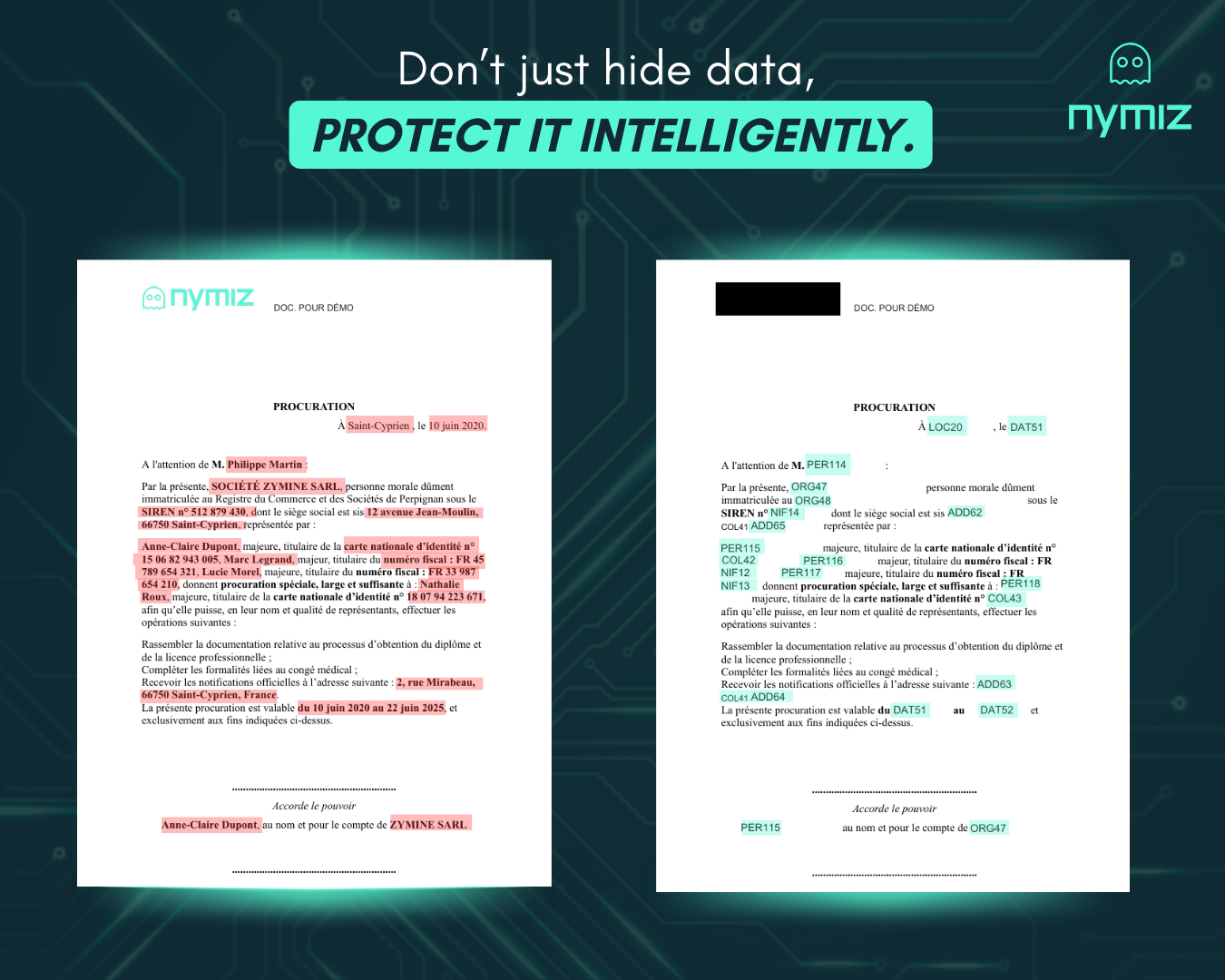
Nymiz addresses this challenge by integrating privacy directly into the legal data infrastructure. Rather than protecting data only at specific touchpoints, Nymiz enables organizations to anonymize and redact sensitive information as soon as data is collected or ingested into legal workflows.

Key capabilities include:

  • Automated detection of personal and sensitive data across documents and datasets using advanced NLP and AI models
  • Consistent anonymization and redaction applied before data is stored, analyzed, or shared
  • Preservation of legal context and structure, ensuring documents remain usable for review, analytics, and AI
  • Flexible deployment options (SaaS, API, or on-premise) to fit existing legal and security architectures

Designed to operate at the infrastructure level, Nymiz supports anonymization across a wide range of formats (including Word, PDF, PowerPoint, text files and images) and in more than 100 languages, making it suitable for global legal operations with diverse data sources.

Building Scalable, AI-Ready Legal Systems

Embedding privacy into data infrastructure allows legal teams to move faster without increasing risk. It enables:

  • Secure reuse of legal data across teams and use cases
  • Greater confidence when adopting AI-driven tools
  • Reduced reliance on manual processes
  • Stronger alignment with privacy regulations and internal governance policies

Rather than acting as a constraint, privacy becomes a foundational layer that supports innovation.

Join Us at Legalweek 2026

We’re meeting with legal and security leaders during Legalweek to discuss how privacy-first collaboration can scale without adding friction or risk.

Schedule a meeting with our team before Legalweek to make the most of your time in New York.

And if you’re onsite, you’ll find us at Booth 612.


A best-of-breed software strategy sounds good, but it creates unexpected problems. Discover why an all-in-one practice management system delivers more value.

Click to download our brochure, The Integration Imperative: How Unified, AI-Powered Platforms Outperform Best-of-Breed Tools in Law Firms by Streamlining Workflows, Reducing Errors, and Boosting Efficiency
Image from brochure


AI in Legal Workflows Needs Real Data: Privacy Can’t Be an Afterthought

AI is rapidly becoming part of everyday legal work. From document review and contract analysis to investigations and predictive insights, legal teams are under pressure to adopt smarter, faster tools.

woman and robot

But there’s a fundamental challenge standing in the way:
AI needs real data to deliver real value.

Synthetic or overly redacted datasets may reduce risk, but they also reduce accuracy, context, and usefulness. At the same time, using real legal data without the right protections increases privacy, security, and regulatory exposure.

This tension is one of the biggest blockers to legal AI adoption today.

The Real Problem: Privacy Comes Too Late

In many legal workflows, privacy controls are applied after data has already been collected, shared, or processed. By that point, risk is already present, and legal teams are forced to slow down, add manual steps, or abandon projects altogether.

What legal AI really needs is a model where privacy is built in from the very start of the data lifecycle.

Enabling AI Without Increasing Risk

At Nymiz, we work with legal and security teams to address this challenge at its root. Our approach ensures that sensitive legal data is protected as soon as it enters the workflow, allowing organizations to:

  • Use real data for AI without exposing personal information
  • Preserve legal context, structure, and analytical value
  • Share and reuse data securely across teams and systems
  • Maintain compliance without sacrificing speed or innovation

By applying automated, context-aware anonymization from the start, legal teams can work with real data at scale.

In practice, this means achieving an anonymization accuracy of approximately 85% in real-world environments, even across multilingual datasets and complex legal documents in more than 100 languages.

Preparing for the Future of Legal AI

As AI becomes more deeply embedded in legal operations, the ability to work with real, protected data will be a competitive advantage. Teams that solve privacy early will move faster, innovate more safely, and scale with confidence.

Join Us at Legalweek 2026

We’re meeting with legal and security leaders during Legalweek to discuss how privacy-first collaboration can scale without adding friction or risk.

Schedule a meeting with our team before Legalweek to make the most of your time in New York.

And if you’re onsite, you’ll find us at Booth 612.


Opus 2 has announced its winter release, delivering the first phase of AI innovation following its acquisition of Uncover. Integrated into Opus 2 Cases, the new suite of AI Assist tools enhance how dispute teams analyze materials, develop strategy, and prepare for trial—offering leading law firms a competitive advantage.

With this release, firms will be able to access a new suite of Opus 2 AI Assist tools including:

  • Matter Assist: Ask questions and get answers that support matter-specific analysis, drafting, and structured insights from all data specific to a matter you’re working on.
  • Document Assist: Receive fast, precise Q&A and task-focused outputs from one or more documents, plus pulling key facts into chronological order.
  • General Assist: Access the latest enterprise version of an all-purpose, leading LLM for handling any non-matter research, drafting, or analysis securely without leaving Opus 2.
  • Prompt Library and Builder: Use our robust library, or create and reuse powerful prompts for consistent, high-quality outputs.

Documents surfaced in Matter Assist or Document Assist can be added to Worksheets and Collections—supporting existing firm workflows and enabling teams to connect documents to issues, events, entities, and evidence. Outputs can also be translated into multiple languages to accommodate multilingual teams.

Users can switch between a Detailed View built on the Opus 2 interface they know, and an Uncover-inspired Focused View delivering a more streamlined experience, while remaining confident that all analysis and output is aligned within one secure, collaborative workspace.

Read the full press release to learn more: https://www.opus2.com/news/opus-2-winter-release-2026/


Get the latest updates on Oxygen Forensics product launches, company milestones, media features, and events. Stay connected with what we’re building, where we’re going, and how we’re making headlines in the digital forensics space.


Oxygen enterprise

 Select to get the latest updates, insights, and resources from Oxygen Forensics Enterprise


Privacy as Infrastructure: A New Standard for Legal Data Protection

privacy nymiz

As legal teams accelerate the adoption of AI, analytics, and data-driven workflows, one question continues to surface:
Is our approach to data privacy actually ready for what’s coming next?

For years, privacy in legal environments has been treated as a reactive measure — something applied once data is already collected, processed, or shared. But this approach no longer holds in a world where real legal data fuels AI systems, collaborative platforms, and complex workflows across teams and vendors.

At Nymiz, we believe privacy must be treated differently.
Not as a feature. Not as a final step.
But as infrastructure.

Why Privacy as Infrastructure Matters for Legal Teams

Legal data is inherently sensitive. It moves across systems, teams, and use cases, from document review and investigations to AI-assisted analysis and reporting. Protecting that data only “at rest” or at the end of a process leaves gaps where risk is already present.

By embedding privacy directly into the data infrastructure, legal teams can ensure that sensitive information is protected from the moment it enters the workflow. This enables data to be safely used, shared, and reused across its entire lifecycle, without compromising confidentiality, compliance, or analytical value.

Privacy as infrastructure allows legal organizations to:

  • Work with real data without increasing exposure
  • Enable AI initiatives without blocking innovation
  • Reduce manual processes and human error
  • Build scalable, future-proof legal data architectures

Moving Beyond Reactive Privacy

As regulatory pressure increases and AI adoption accelerates, reactive privacy models are becoming a liability. Legal teams need a proactive, structural approach that aligns with how data is actually used today.

Privacy as infrastructure isn’t just a technical shift, it’s a strategic one. It transforms data protection from a compliance burden into an enabler of innovation and operational efficiency.

Join the Conversation at Legalweek 2026

Ahead of Legalweek 2026, we’re inviting legal and security leaders to rethink how privacy fits into modern legal data strategies.

If you’re attending Legalweek and want to explore what privacy as infrastructure looks like in practice, and how it supports AI, analytics, and collaboration, we’d love to connect.

Visit Nymiz at Legalweek 2026, Booth 612
Let’s talk about building legal data systems that are protected by design, not patched after the risk appears.


One question, 14 legal industry experts

Artificial intelligence is reshaping litigation faster than any prior wave of legal technology. From discovery and case strategy to billing models and governance, AI is changing what clients expect and how firms compete. Bringing together perspectives from senior litigators, innovation leaders, and legal technologists, this eBook asks the question:

The future of AI in litigation: Predictions and advice from legal industry experts offers a variety of topics for consideration including:

  • AI as a force multiplier for litigation strategy and advocacy
  • Predictive discovery and faster, insight-driven case development
  • Governance, transparency, and defensible use of generative AI
  • Shifting economics, billing models, and client expectations
  • Cultural change and the evolving role of the modern litigator

Gain practical, experience-based insight into how litigation is changing—and what firms must do now to stay competitive. The eBook is available now and features experts from White & Case, Orrick, Baker Botts, Burges Salmon, and more. Get it here.

Read the full announcement here.