Your SaaS vendor’s recycle bin shouldn’t be a backup strategy.
One of Germany’s largest law firms realized this before it was too late.
Click to see how HEUKING protects iManage Cloud data, even during disruptions, with HYCU.
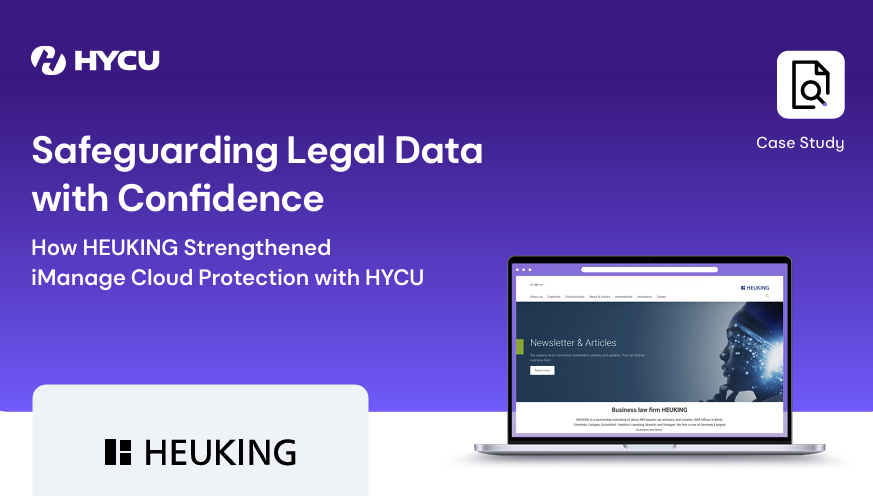
Your SaaS vendor’s recycle bin shouldn’t be a backup strategy.
One of Germany’s largest law firms realized this before it was too late.
Click to see how HEUKING protects iManage Cloud data, even during disruptions, with HYCU.
During LegalWeek, we will be placing a one-of-a-kind 3D printed piece of art! There will be ONLY 20 of these placed around the show throughout the conference.

Here’s how to play:
How much time is your firm spending on manual email filing?
In this case study, Fournier details how adopting Colligo Email Manager for Microsoft 365 helped improve matter organization, reduce time spent managing email, and enhance compliance with legal retention requirements.
The result: stronger governance and more time for client-focused work.

Read more: https://www.colligo.com/legal-department-saves-up-to-80-hours-a-year-per-person-with-email-manager/
Turn institutional knowledge and best practices into structured, repeatable processes, scaling standards across teams.

Control Risks, a global leader in investigations, litigation support, compliance, cyber incident response, eDiscovery and digital forensics services, today announced it will exhibit for the first time at Legalweek on March 9-12, 2026, in New York, appearing near the exhibit hall at meeting space 738.
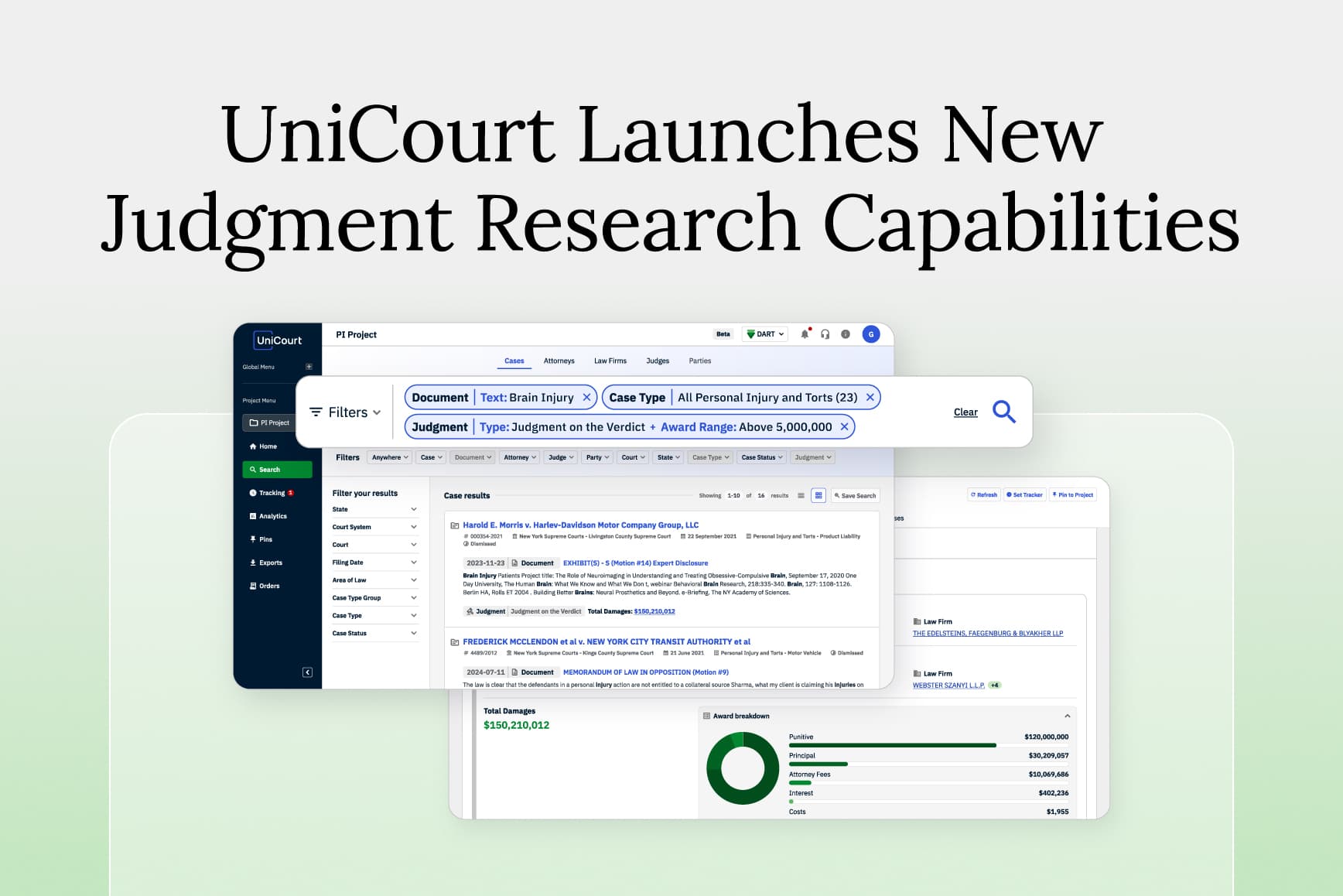
UniCourt’s newly released judgment research capabilities offer a major advancement in litigation research, enabling legal professionals to assess case values and risk based on actual case outcomes. Users can now answer complex questions about verdicts and judgment outcomes to answer questions such as “which personal injury cases involving a traumatic brain injury received judgment amounts over $5 million in the last five years?” This new feature is a significant expansion of UniCourt’s existing powerful AI search capabilities.
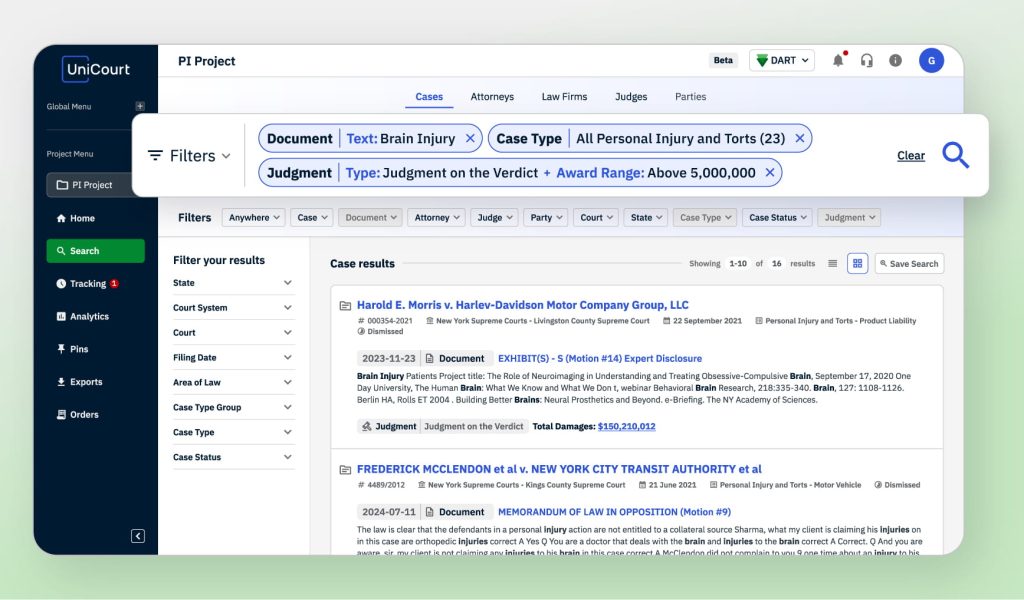
By using UniCourt’s AI-powered natural language search, legal professionals can easily:
By using UniCourt’s new judgment filters, legal professionals can easily:
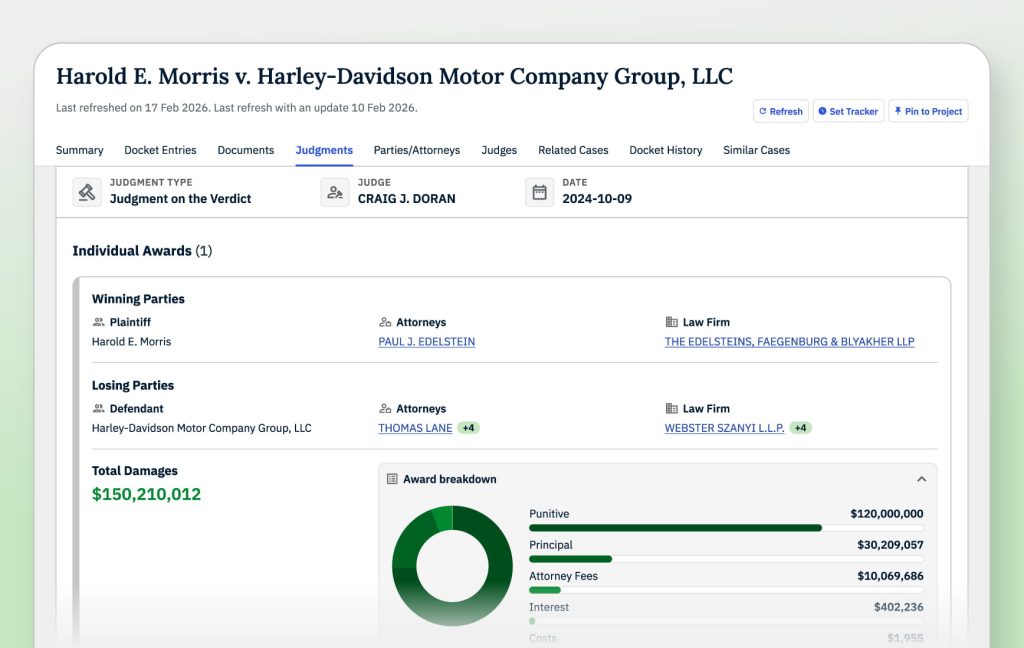
By using UniCourt’s comprehensive judgment data, legal professionals can easily:
Understanding the final outcome of a case is a critical aspect of litigation research. Judgments represent a vital link in UniCourt’s unique Litigation Knowledge Graph, which connects case claims, facts, and outcomes directly to the underlying documents and the key players involved. This provides legal professionals with a comprehensive, 360-degree view of the litigation landscape.
UniCourt’s new judgment search is currently available for several major jurisdictions, with a nationwide expansion and judgment analytics coming soon. You can learn more about UniCourt’s platform here, see our full press release here, or contact a UniCourt Litigation Data Expert here.
Your Organization’s Data Sovereignty Posture Looks Strong on Paper. The Data Says Otherwise.
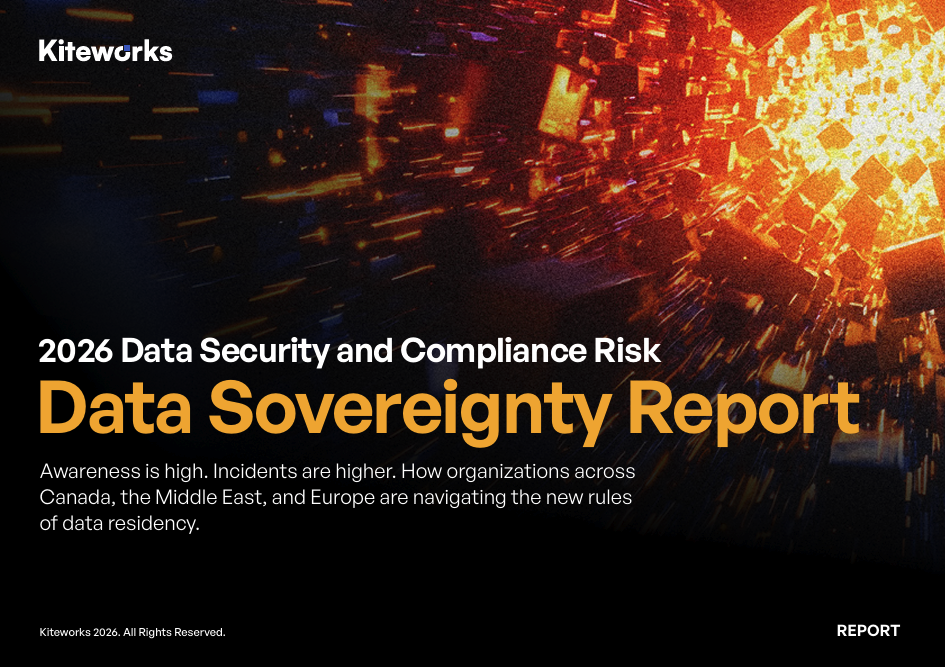
A new report from Kiteworks surveyed security, compliance, and IT professionals across Canada, the Middle East, and Europe — and the findings should give every legal professional pause. The headline: 80% of organizations say they’re well informed about data sovereignty requirements. One in three experienced a sovereignty-related incident in the past 12 months anyway.
Whether you’re in-house counsel managing your organization’s cross-border data risk or outside counsel advising on regulatory exposure, that disconnect is the story. Organizations aren’t getting caught by regulations they haven’t read. They’re getting caught by infrastructure that can’t enforce what their policies promise. And in a regulatory environment that’s shifting from breach penalties to control-deficiency enforcement, the gap between stated compliance and provable control is where liability lives.
The Awareness Trap — and Why It’s a Legal Problem
The Kiteworks 2026 Data Sovereignty Report found that self-reported awareness is remarkably consistent across regions — roughly 44% of respondents in Canada, the Middle East, and Europe describe themselves as “very well informed.” Another 36% say “well informed.” On paper, that looks strong.
But awareness hasn’t translated into protection. Nearly one in four Canadian organizations experienced a sovereignty incident last year. In Europe, that figure hit 32%. In the Middle East, it reached 44%. The most common incident types — data breaches with sovereignty implications and third-party compliance failures, each at 17% — are exactly the kinds of events that trigger regulatory investigations, plaintiff discovery requests, and board-level scrutiny.
Here’s where it gets uncomfortable for legal teams: once an organization documents that it understands its sovereignty exposure — through a DSPM scan, a compliance assessment, or even a report like this one — it has actual knowledge. And every major regulatory framework treats actual knowledge as a trigger for affirmative obligations. Knowledge without remediation isn’t just a risk management failure. It’s the foundation of a negligence argument.
The CLOUD Act: A Jurisdictional Risk No Contract Can Close
For legal professionals on either side of the table — corporate counsel evaluating vendor risk or outside counsel advising on cross-border data flows — the U.S. CLOUD Act remains a structural exposure that no contractual language can resolve. Over one in five Canadian respondents flag it as a direct sovereignty threat. When an organization stores data with a U.S.-headquartered cloud provider, that data may be subject to U.S. government access requests — regardless of where the server physically sits. Data on a server in Montreal, managed by a U.S.-headquartered provider, is not beyond the reach of a U.S. court order.
This matters for litigation strategy, not just compliance. In cross-border discovery, hosting decisions and data handling protocols are the front line of risk management. Nearly a quarter of Canadian respondents are already migrating away from U.S. providers — a signal that legal teams advising on vendor selection, DMS governance, and data residency should be tracking closely.
The Mid-Market Is Exposed — and Underrepresented in the Conversation
The report’s findings on the size gap should be front of mind for corporate legal departments at mid-market companies and the outside counsel who advise them. Sovereignty maturity scales with organization size, and mid-market firms are falling behind by 15 to 25 percentage points on virtually every measure — awareness, spending, incident response planning, and automation investment.
These organizations face the same PIPEDA obligations, the same CLOUD Act exposure, and increasingly serious enforcement. Quebec’s Law 25 can impose penalties up to C$10 million or 2% of worldwide turnover. The EU AI Act introduces fines that can reach €35 million or 7% of worldwide annual turnover. Same regulatory surface area, a fraction of the budget. For legal teams, that asymmetry is where client and organizational liability concentrates.
AI Governance: The Next Discovery Battleground
Roughly a third of organizations use a mixed approach to AI training data based on data sensitivity, while a similar share keep all AI data within their home region. The problem: a “mixed approach based on sensitivity” is only defensible if the classifications are documented, auditable, and consistently enforced. For most mid-market organizations, they’re not.
With the EU AI Act now in effect and enforcement frameworks tightening globally, organizations without formalized AI data governance are carrying exposure they may not fully appreciate. Plaintiff’s counsel are already beginning to request AI governance documentation and data-handling protocols in litigation. Legal professionals who drive the creation of defensible AI policies now — whether building the framework in-house or advising on it from outside — are closing a liability gap before it becomes an exhibit.
From Stated Compliance to Provable Control
The shift the report identifies — with particular urgency for legal professionals — is from stated compliance to provable control. Regulators, courts, and opposing counsel have moved from accepting policies to demanding proof. That means data residency enforced through technical controls, not contractual promises. Encryption key custody retained within the organization’s jurisdiction. And exportable evidence — immutable audit trails and compliance documentation that can be produced on demand and survive judicial scrutiny.
More than half of respondents plan to invest in compliance automation over the next two years precisely because the evidence gap is where enforcement exposure concentrates. For legal teams, the practical question has changed: it’s no longer “Are we compliant?” It’s “Can we demonstrate where our data lives, who holds the keys, and what our exposure looks like if a foreign court order or discovery request reaches our provider?”
Get the Full Report and Regional Summaries
The full Kiteworks 2026 Data Sovereignty Report is available for download.
Regional executive summaries are also available for Canada, Europe, and the Middle East.
Most litigation strategy is shaped in state trial courts, yet much of the legal research ecosystem remains centered on appellate opinions rather than the procedural patterns, judicial tendencies, and real-world outcomes that define trial-level practice.
As timelines compress and clients expect faster, more informed guidance, early clarity has become essential. The ability to assess risk at filing, evaluate judicial context, understand opposing counsel patterns, and anticipate motion and expert dynamics can materially influence the direction of a case.
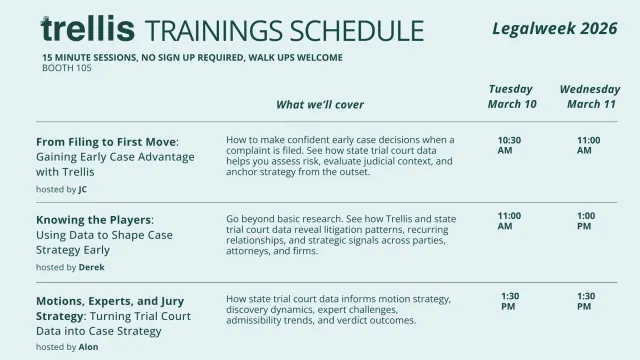
At Legalweek 2026, Trellis will host a series of live training sessions demonstrating how structured state trial court data can inform litigation strategy from filing through trial preparation.
The sessions will take place at Booth 105. Each session runs 15 minutes. Walk-ups are welcome and no registration is required.
In today’s increasingly digital legal environment, firms need more than disconnected tools and legacy systems. They need a unified, intelligent platform that brings every aspect of their practice together.
AllRize delivers a comprehensive, AI-powered practice management solution that integrates marketing, client intake, matter management, document management, accounting, and governance into a single cloud-native SaaS platform. Built on Microsoft Dynamics 365 and hosted on Microsoft Azure, the system combines enterprise-grade security, reliability, and scalability with seamless integration into familiar Microsoft tools such as Outlook, Word, Teams, and SharePoint.

Key differentiators include:
• A fully unified practice management environment with everything in one place
• Modular architecture allowing phased deployment by business need
• Native Microsoft Dynamics 365 integration
• Embedded Generative and Agentic AI powered by Microsoft Copilot
• Automatic cloud updates with no on-premise infrastructure required
Through deep legal industry expertise and continuous customer collaboration, the platform is engineered specifically for modern law firm workflows. The result is a digitally powered firm with greater efficiency, stronger client service delivery, improved profitability, and scalable growth potential.
Learn more or schedule a demo at: https://allrize.ai/wp-content/uploads/2025/03/Comprehensive-Practice-Management-for-Digitally-Powered-Law-Firms.pdf

Paulina Grnarova CEO & Co-Founder at DeepJudge
Today, I’m proud to announce our partnership with Thomson Reuters (TSX/Nasdaq: TRI), the global leader in content-driven technology for legal professionals. This collaboration will bring our AI-powered enterprise search to law firms and legal departments through Thomson Reuters’ trusted legal platforms and expansive customer network.